Tuesday, May 15, 2007

Honoring Randomness

At the end of the month is Memorial Day, a holiday when those who are aware of the original purpose of the day will honor those who have died for this country. As for me, I'll be thinking of those currently serving, with the hope that next year I won't be honoring their ultimate sacrifice.

One would be forgiven for thinking that a scholar of military politics such as I would be accustomed to the cost of war. However, once in a while the War Against Terrorism is made personal to me. Such was the case earlier this month. One of my best students had to drop out of college only weeks before the end of the semester because he's being shipped out for his 3rd tour of duty in Iraq -- the first was during Desert Storm, the second during the current conflict.

What struck me the most was that he didn't believe his fellow students would care why he was leaving the class. The following week I asked the students and most said that they did care, hoped he stayed safe while there. Yet, while some pointed out that I was correct in that knowing someone who was going made the conflict a little more personal to them, most seemed to be looking forward to summer vacation more.

At the beginning of summer, when most folks see a three-day weekend, honor those who have fallen and give a thought to those who put their lives on the line as members of the military -- Give a thought to the California National Guard; the mothers, the fathers, the sons and daughters, the students who give up their everyday lives to serve in a land too far away -- may they all come home safe and next year they can have their three-day holiday weekend.

DB, my quizzes may be hard, but at least you don't need body armor to survive them. Be safe.

Tuesday, April 03, 2007

Applying Randomness

I worked rather hard on my application for a fellowship, but in the end it was probably my lack of a tenure track position that kept me from getting it.

Bummer.

The hardest part of the application was the essay portion. Applicants had to write no more than 250 words for each of the three topics. No academic is ever that concise. It is rather difficult to cover such complex issues in so little space. But I was up to the endeavor. See for yourself:

1. Define terrorism and explain how it constitutes a legitimate or illegitimate use of force. Please provide one or more real world examples about the use of terrorism to make your case.

Terrorism is a tactic used by organizations and institutions to influence or modify the behavior of a populace or a government through the use of fear or, as the term implies, terror. When this tactic is used by non-state actors, it cannot be considered to be the legitimate use of force, as this is the purview of governments. That is not to say that all acts of terrorism are de facto illegitimatized. There have been cases where governments have overstepped the bounds of the use of force to cow a population of a conquered territory and have been met with armed resistance. This resistance is then labeled ‘terrorism’. The early years of the Irish Republican Army is an example of this. However, most groups resorting to terrorism do not directly attack agents of a government, but rather the innocent non-combatant in hopes of using fear on the part of the whole population to drive the government into complying with the demands of the group. This is the case of the more recent activities of the IRA. While some groups attempt to maintain their legitimacy by attacking solely military or governmental targets, a degree of innocent civilian causalities can be expected. The likelihood of this depends on the type of
attack used. The more indiscriminate the attack – the use of bombing a clear example of this – the more likely a by-stander will be harmed. This in turn decreases the credibility and legitimacy of the organization engaging in terrorism.

2. If you could make one policy prescription to bring the war on terrorism to a successful conclusion, what would it be and what would a successful conclusion look like?

Terrorism is a tactic, thus it is diffi cult to have a ‘war’ against a tactic. To successfully bring an end to terrorism, those fi ghting against it must understand the underlying cause that drives rank-and-fi le members of terrorist organizations to see it as an acceptable tactic. Only when terrorism is seen as a symptom of a societal ill can progress be made.

Most terrorist organizations are driven by economic realities. When unemployment is unnaturally high within a segment society, that segment will engage in violence. One need only look at the gang activity within the US to see this. The solution is not to combat terrorist activities with traditional military methods, but rather go to the heart of the problem – the economic imbalance. Repression by the state, rather than economic engagement, will merely create another generation of the disenfranchised who will turn to violence as a means of self-expression. When the community has a vested interest in protecting their own economic well-being in the face of violent activities by fellow community members, a mode of self-policing can begin. The necessary weapon against the development of terrorism is economic development, not merely humanitarian aid. The current situation in Palestine is a case in point. Álvaro de Soto pointed out that there is ‘cause for alarm’1 in the dependency on handouts in that there is little in the way of self-reliance in the region. Without economic development, there will be little need for the Palestinians bring about an end to the terrorism by a portion of their society.
1 Steven Erlanger; “Aid to Palestinians Rose Despite an Embargo”, New York Times; March 21, 2007; A1

3. Discuss some of America’s successes and/or failures in fighting terrorism at home and abroad.

The lack of attacks against American soil is often offered as proof of our success in combating terrorism domestically. However, the diffi culty lies in trying to prove a negative: is the lack due to our preventative measures or their lack of attempts. Internationally, our successes have been a little more identifiable. A large number of countries have joined the United States in blocking the use of the world’s fi nancial systems by terrorist organizations, making it harder for those organizations to raise funding. Likewise, Libya, once a notorious sponsor of global terrorism, has dismantled its weapons program and distanced itself from groups such as
al-Qaeda as a result of economic sanctions.

Failures, however, are easier to identify. As Jessica Stern noted, “[The] bombing of the United Nations headquarters in Baghdad was the latest evidence that America has taken a country that was not a terrorist threat and turned it into one.”1 The sponsorship of Hezbullah on the part of Syria and Iran has markedly increased since the start of the war against global acts of terrorism. Al-Qaeda has become a hydra, in that each time the American military succeeds in capturing or killing a high-ranking member of that organization, two or three members step into the breach. Likewise, on the domestic front, the passage of laws that decreased the civil liberties of citizens can only be seen as a failure if the purpose of fighting the war on terrorism is to promote civil liberties globally.

1 Jessica Stern; “How America Created a Terrorist Haven”, New York Times; August 20, 2003; A21

Much thanks is due to my Sanity Touchstone -- BM, you know of whom I speak -- for letting me go through my mental meltdown on his shoulder. Spring Break is over and now it's back to torturing students with homework....

Wednesday, March 07, 2007

Random Connections

Across the hall from my university office are several Linguistics and Language Development instructors. When we all were told we were moving into the building, and that departments would see their professors' offices spread through out the floor, some of us were doubtful that would really lead to more collegiality among the departments -- some thought it would merely make us feel isolated. As it turned out, I now speak more often with my LLD neighbors than I do most of my department members. We've shared tips and ideas, triumps and lows, and we're all the richer for the daily interaction.

It was one of those tips that leads to today's blog entry.

Last semester, I taught the Writing for the Major course for my department. I had my students write in blogs as part of the course. That seemed to work really well, in that a good number of the students took the assignment to heart and wrote about all the issues and interests that caught their attention. More importantly, even the students who had grudgingly wrote their entries each week agreed that, by the end of the semester, their writing had improved from the sheer fact that they were sitting down and writing an entry each week. Or perhaps they were just telling me what they thought I wanted to hear.

I mentioned this to one of the LLD instructors across the hall and managed to overcome his reluctance to consider blogs as a legitimate writing tool. Or maybe he was already considering it, and told me that I had convinced him in order to get me to stop nattering on about my students' blogs. Regardless of why he decided, he now has a blog himself: The Olive Rooted with connections to his students' blogs.

Thus, if you have a chance, please pop over to his site and read what his students have to say. Or, at very least, get view on the whole CSU Contract Negotiation issue from someone who has a vested interest in the outcome.

Friday, February 09, 2007

Voting Randomly

Anyone who knows me knows that I'm not in favor of mandatory voting. If the ignorant schmucks don't want to vote then they should not be forced to by the government.

In 1993, the federal government passed the National Voter Registration Act (Motor Voter Law) to make it easier for people to register to vote. Perhaps too easy. At one point, I had two cars; one registered in Santa Barbara and the other in San Jose -- the two places I spend a good part of the month commuting between -- and for the next two elections I received sample ballots at both addresses because the DMV registered me at both locations. If I were inclined, and I'm not, I could vote in the morning in one place and drive to the other to vote in the afternoon.

One man, one vote; one Professora, two votes....

It would seem that I'm not alone. The National Center for Policy Analysis reported that in Los Angeles County there were 78,000 duplicates out of the 3.6 million voters registered there. It would seem that a number of them took advantage of this and actually did vote multiple times.

If that weren't bad enough, the same report showed that the State of California estimated that between 14 to 24 percent of the registered "voters" were illegally on the voter rolls. Seems that the state, in its attempt to clean out possible fraud, sends out postcards to voters who haven't voted in a while, and only if the card is returned as 'undeliverable' by the post office is the voter struck from the rolls. I happen to know for a fact that the dead of Santa Barbara rise on Halloween to vote in the November elections -- my mother, who had been dead for two and a half years, voted in the 1994 election: "her" signature was there when I went to sign mine right below. Yes, I had visions of 1960 Chicago.

But even if all the "deadwood", as the Californian secretary of state calls the deceased voters, were eliminated from the rolls, it wouldn't change a basic fact: Californians, like most US citizens, do not do their civic duty on a regular basis. The state reported that in the last election, 56.2% of the registered voters went to the ballot booth. That seems impressive, except when you realize that the qualification is 'of registered voters'. Of a population just over 37 million people, fewer than 16 million are registered. What this means is that when calculating the percentage of people who voted against the total who are eligible to vote, the number drops to below 40%.

Some scholars like to point out that the reason why voter turn out has been so low is that the youth of the country cannot be made to care about politics. They may have a point. In 1971, the 26th Amendment to the US Constitution was passed, giving the right to vote to 18-year-olds. Thus it was that over 11.5 million voters were added to the voter rolls in one fell swoop. The following year, 55% of 18-24 year olds voted. Sadly, by 2000, that number had dropped to 37%. That was a presidential election year -- the trend is that more people, regardless of age, vote in those elections than in non-presidential elections. In 2002, a non-presidential year, youth turnout dropped to 19%.

The solution, says Assemblyman Joe Coto (D-San Jose), is to make graduating high school students register to vote or they can't have their diploma. Well, except if you're not old enough to vote. Or you're not a citizen. Or if you put your opt-out request in writing....

this could be as silly as the proposal put forward in 2004 by Senator John Vasconcellos (D-Santa Clara) which would give 14-15 year olds a quarter of a vote and 16-17 year olds a half of a vote as a way of 'electoral apprenticeship', as "Training Wheels for Citizenship".


The problem isn't that the youth of America aren't voting -- that's a symptom of something greater: a severe lack of understanding of government and political issues. A survey of California high school students done by the California Campaign for the Civic Mission of Schools showed that "Despite taking a course in U.S. government in their senior year, students' knowledge ... is modest, at best. Students only averaged a little over 60 percent correct on the commonly used survey items designed to test civics content knowledge, a low 'D' on common grading scales." Their senior year!

I'm sorry, if the high schools are turning out students who barely understand the political process, I don't want these ignorant schmucks voting. So, let's not require them to register to vote in order to graduate; let's make them score higher on civics knowledge surveys before allowing them to graduate, let alone allowing them anywhere near a ballot box.

After all, we expect immigrants to pass a citizenship test before they're allowed to vote, why should we expect less from those ignoramuses who were merely lucky to have been born here?
Photo Credit: http://www.yougottareadthis.com/img/al-gore-florida-voter-1.jpg

Wednesday, January 10, 2007

Having Your Randomness and Eating It Too

Those in the know are aware that La Professora has, for some time, been studying Spanish Politics and Nationalistic Terrorism. So, it should come as no surprise to them that I would write a blog entry about the recent ETA (Euskadi Ta Askatasuna -- Basque Homeland and Liberty) bombing in Madrid, Spain.

Last spring, when I traveled to Spain to do some research on terrorism in that country, it was only days after the group had declared a "permanent" ceasefire. My goal at the time was to write on the relationship between the democratization process and the end of nationalistic terrorism in that country. The point of the effort was a paper that countered the Bush Administration's assertation that bringing democracy to Iraq would bring an end to insurgency in that country. The ceasefire in Spain gave me at least an end point: roughly 27 years after the constitution was passed; 24 years after the Socialist Party won office away from the former regimists.

And now it seems that the permanency of the ceasefire is questionable. The Spanish government had been negotiating with the political wing of the terrorist group to bring the nationalists in line with the democratic process and a true end to the violence, and with the bombing the government has put an end to those negotiations. Juan Carlos I himself called the attack "cowardly and vile".

On the other hand, the political leader of the organization is running on the assumption that the negotiations will continue. Arnaldo Ortegi claims that peace is still at hand if "we all act responsibly". Seems that the ETA was upset that the negotiation process was not speedy enough for their liking and the bombing was, if you'll pardon the analogy, to light fire under the government. In the statement issued by the terrorists, they expressed their condolences to the families of the two victims; however, they placed the blame for those deaths on the government and the security forces -- after all, the ETA called three times to warn of the bomb. It seems only fair, the political leadership seems to be saying, that the government continue the discussions as the group is only responsible for the bombing, not the deaths that resulted from that bomb. Now, says ETA, the government will stop "constantly putting obstacles in the way of the democratic process" because they've been reminded of what's at stake. As far as the group is concerned, the "permanent" ceasefire is still valid. A clear case of the ETA believing it can have its cake and eat it too.

This bombing is just one more in the long list of terroristic acts carried out by the Basques. Whether there will ever be real peace in democratic Spain is a question that will not be answered anytime soon. But the situation does answer the question as to whether there will be a cessation of violence in Iraq if the US is successful in establishing a truly democratic state there. If Spain is still trying after nearly three decades then I can with some certainty say that there will be no quick end to the violence in Iraq, whether the U.S. Boys in Fatigues are there or not.
Photo Credit: http://www.elmundo.es/albumes/2006/03/22/tregua/index.html

Wednesday, January 03, 2007

Random Bias

If I've taught my methodology students anything, it's that one should own up to one's biases. When doing research -- and by that I mean real research, not the stuff students do in a library -- political scientists must identify their own biases in hopes that it will make their studies more scientific. That being the case, I have always identified to my students my political ideology.

I am a good Southern Democrat -- not a Dixiecrat, which is vastly different -- a social liberal and a fiscal conservative: I believe that we should help everyone in need, just not with my tax money.

But now, I find out, I can be kept from doing my civic duty of serving on a jury for the mere reason that I am an instructor, because everyone knows that teachers are notoriously liberal and will always find in favor of the defendant.

Okay, I will admit that traditionally there have been a greater number of liberals than conservatives in the teaching profession, and there's no concrete evidence as to why that is. Some say it's because only liberals would take such a thankless job at such low pay. Some say that only liberals feel the need to serve the community, whereas conservatives only serve themselves. Still others say that liberals become involved in education because it's the only place where their ideology can be indoctrinated into the young. Perhaps there's some small truth to any of those ideas, but that would hardly explain my Republican colleagues in the department.

As I did, these colleagues gave up the possibility of very lucrative careers to be paid very little of what they are worth -- both in terms of what it took to get their degrees and what they bring to the classroom -- and they certainly do not think their job is to counteract any liberal 'indoctrination' the rest of us are accused of instilling in our students. If anything, we all rejoice in the diversity of opinion that is expressed. One of my favorite courses as an undergraduate was team-taught by a conservative and a liberal, which made for a very interesting and informative course on War.

In my classes, it quickly becomes clear: I do not care what your political flavor is, you must be able to defend your position or opinion with logically presented evidence. I have played Devil's Advocate so many times, arguing alternatively the extreme right or the extreme left positions, that most of my students forget what my ideology is. In point of fact, one budding journalist, who visited my classroom when I had a guest speaker talk about his work in a Republican assemblyman's office, wrote that I agreed with all things conservative.

Which just goes to show that the other part of Deputy District Attorney Gregory Dolge's statement, that journalists are also notoriously liberal, is wrong. The young man reporting on my visitor's presentation was clearly of the conservative bent. He follows in the footsteps of other 'notoriously liberal' journalists: Pat Buchanan, George Will, and Bill O'Reilly, to name a few.

So, thanks to the California Appeals Court, I cannot do my duty as a citizen because most of the members of my profession are liberal. My students would recognize
this -- or should, else their grade in the course be subject to question -- as an ecological fallacy, which is the origin of stereotyping. Which in and of itself is a form of bias. That's okay, said the Appeals Court; society can discriminate against me because of my profession, so long as it doesn't consider my gender into the equation.

Oh, how I long for the day when I could be excluded from the jury pool because my degrees made me "too smart" for lawyers' comfort.
Image credit: http://www.courts.wa.gov/newsinfo/resources/

Friday, December 22, 2006

Merry Randomness....

It's that time of the year again.

No, I don't mean the holidays when you travel hither and yond, visiting relatives, praying that the airport isn't snowed in -- or covered in a thick fog -- smiling as you thank Aunt Eunice for the lovely sweater she knitted using her dog's fur.

I mean the post-semester complaints from students.

All the papers have been graded -- some of which were schlepped to England, and graded on trains and planes. The course grades have been posted. You'd think that my job is now done and I'd settled into a long, well-deserved nap on the Winter Solstice.

No such luck.

The grades hadn't been posted for more than few hours and the emails began.

"Why did I get a 'D'?" Hmmm. Could it be that you didn't do all the homework and tanked on the final exam? Thought so. And no, I don't give extra credit after the semester is over because I don't feel like spending any of my precious vacation time reading the crap you were too lazy to do when you had the chance the first time.

"Can I turn in some of the homework assignments now, to raise my grade?" At one time, a long time ago, when I first started teaching, I was a soft touch. A real softy. Okay, not so such of a marshmellow that I'd let students turn in their essays in yellow ink, but I'd listen to their sob stories and give them the benefit of the doubt. Since then, the department has gotten a little tougher on students because we've seen a kid go through chemotherapy in the morning, show up for class in the afternoon, and still get his work in on time. I know that most students don't have quite that force of character, but still -- not being able to do the work that was assigned, on time, because you have other priorities doesn't make it my problem. As someone once said, A lack of planning on your part does not constitute an emergency on mine.

"Is there any way I can talk you into raising my grade?" I kid you not, I once had a student tell me that she really enjoyed my course, learned a lot, and earned the grade she got, but could I change her grade so that she would have the minimum GPA to join her preferred sorority. Uh, no. If your GPA is too low to join a House, then it's too low, period. Not to bash too heavily on the Greek system -- some of my better students have been members, but some of my less than stellar students have been too -- but I've gotten reports from two different sources that one House objected to a requirement that the memebers fullfil a minimum study time of 4 hours per week. Seems it would cut into their "social time". You want me to raise your grade, out of the goodness of my heart, so that you can join a House that might cause you to go completely off your academic rails?!

I don't think it's too much to ask that, just once, I could relax on a cold -- well, cold for a California coastal town -- winter night with my Love, drink hot cocoa, and let the worries of the past semester fall away, without students electronically jumping up and down, demanding a better grade. It makes me feel like an academic Scrooge.

To those of you in the 'real' world, I wish you Happy Holidays; to my fellow academics, try to have a quiet, student-complaint free vacation; to my students, take the holidays to breathe, assess your priorities, and prepare for the upcoming semester. If you still feel the need to discuss your grade, I'll be in my office starting the 2nd of January.

Until then, could I please have some quiet here?

Sunday, November 12, 2006

The Price of Randomness

I never been one for conspiracies, but something rather odd is happening at Bay Area gas stations.

In the weeks leading to Election Day, the price of gasoline had been steadily going down. Back in May, the price of a gallon of 87 octane gas was $3.25 -- by European standards that was still rather cheap, but still rather high for the US. From that high it had been steadily, by two or three cents each time, decreasing. Three months later, at the same station, the price was at $2.98.

Then the run up to the elections began. Newspapers covered the ballot measures and the various impacts each would have. One of those measures was the “Alternative Fuel fund” which would require oil companies to pay into a research fund that would make their industry less lucrative in the long run.

The price of gas began to steadily decline.

A barrel of oil hardly dipped at all, and at times would rise to a new high; yet the price of a gallon of gas continued to fall at the local station.

Within two months, the cost of filling up my gas tank dropped to a level less than it had been all year. On Election Day, it was at $2.25 – a full dollar less than it had been five months before – for a gallon of the low octane gas at the station I’d been watching. There were similar low prices at all the local stations.

The day after the election, each of those stations raised their prices. Not by a couple of pennies, but by as much as 8 cents. On Saturday, I drove by the local station and imagine my surprise when I saw that they had raised the price again, by another 6 cents: a total of 14 cents altogether.

On Tuesday gas was $2.25 and on Saturday it was $2.39! Within the space of four days, it would now cost me a little over a dollar and a half more to get a full tank of gas. In four days, the price rose to a level from which it took a month to creep down, pennies at a time.

I don’t consider myself to be paranoid or given to conspiracy theories, but something rather odd is happening at Bay Area gas stations, and I don’t think it was merely increased demand on the part of drivers – that can happen around the holidays. I think the oil companies were trying to win California voters over, making us think that gas prices weren’t that bad and we don’t really need to pass a measure that would make them pay into a fund that would go toward research that would make their own product less in demand. Perhaps we bought it, because the measure was voted down.

Then the price of gas went back up.
Photo Credit: http://politicalhumor.about.com/library/images/blpic-gasprices.htm

Saturday, November 11, 2006

Honorable Randomness

Eighty-eight years ago, on this day, the big guns of World War I were silenced. The world celebrated the end of the “War to End All Wars”. For a while, this day was known as Armistice Day, a day of peace.

Then World War II came, and we had peace no more. Armistice Day gave way, to be known as Veterans’ Day. And we honored those who fought for our nation and its security.

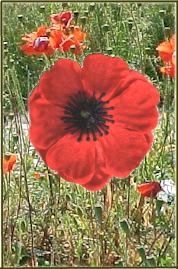
As it was the first flower, and in some places the only flower, to bloom in the bloody battlefields of Europe, a tradition began after the 1918 Armistice of wearing a red poppy to honor those who fought bravely for their nations and the security thereof. Some still honor the warriors – from all wars – by wearing the Red Poppy.

Most, however, do not.

They have no clue what the Red Poppy means. They see the day as a holiday – freedom from work or school.

War is so removed from our everyday lives. It’s something that happens “over there”, not here. Here, we have a day of leisure and relaxation. Have a drink, it’s not like you’re going to be drafted and sent off to defend your country.

On this day, I’ll be wearing the Red Poppy in honor of those who did go off and defend our country, because war is not as removed our lives as one might think.

On this day, I’ll be thinking about the student who was called back to duty and shipped out to Afghanistan in the days after September 11, 2001. I’ll be thinking of the students who had to drop out of college because they couldn’t find a way of fitting their class schedule around defending the local airport as part of the National Guard. I’ll be thinking of the students who had to put their education on hold when they were deployed to Iraq. I’ll be thinking of them because a handful of them were in my classes.

There was the student who came to class in fatigues and said that if his phone went off, he’d have to leave because they were on alert after 9/11. Twenty minutes into the lecture, his commanding officer called. I gave him an incomplete and was pleased that he survived to finish the course when his battalion returned from Afghanistan.

There were the two National Guard students in my class who had to drop all their courses because they were required to put in 50+ hours a week defending the Santa Barbara airport from terrorists. They couldn’t attend class, and didn’t have time to study; they had to drop out because no one could tell them how long their guard duty would last. Thankfully, the silliness of guarding the SB airport didn’t last as long as some had thought – if you’ve ever been through SBA, you’d understand why it wouldn’t be high on the Al Qaeda list of targets – and the student warriors were able to return to school.

Only to have to leave it again when the National Guard was called up and shipped to Iraq, along with the recently graduated Army ROTC students. One of whom I knew wanted to go on to law school so that he could be come military lawyer. That would have to wait, the war in Iraq had begun.

It is to them, when I have a drink this evening, I toast. It is for them, and the thousands like them who will not be having a simple day of leisure, that on this day I wear the Red Poppy.

What did you do to honor them on Veterans’ Day?
Photo Credit: http://www.warmemorialsnsw.asn.au/traditions/poppies.cfm

Friday, November 10, 2006

Random Games

Most students of Political Science have heard of the Game Theory. Few have seen it in action. Over the weekend, I had the joy of doing just that.

My Gentleman and I went to Phoenix for the first weekend in November and had the (mis)fortune of staying at the same hotel as a visiting high school band. Visions of giggly, screaming, hormone-driven teenagers put a bit of a damper on our romantic inclinations. Surprisingly enough, the kids were rather quiet once 10 o’clock rolled around.

Sure, prior to that we could hear them banging around and chatting as they gossiped up and down the hallway. But the few chaperones shepherded the students into their rooms and there those kids stayed.

I was amazed at how the limited number of adults – probably in great need of sleep after a day of dealing with a marching band full of teenagers – managed to keep the kids in their rooms and out of trouble. Around 11pm, my Gentleman had gone out to get some ice for his Coke and came back with the answer.

The solution to keeping all the students in their rooms was to put a piece of cellophane tape over the gap above the doorknob on each door. It if was broken when the chaperones went to knock on the door to wake the occupants up in the morning, then all the students within that room were in trouble.

It had me thinking about Game Theory.

Given that each room has a phone, and thus the occupants could call each other and arrange a “jail break”, it would be possible to communicate and plan. All students who wished to break out and sneak from room to room could conceivably do so. The problem would be that only the last student to return to his/her room would have the telltale broken tape, as that student would be able to replace the tape to everyone else’s door, thus the only ones who would be punished would be the occupants of that last room.

Given this scenario, what would you do?
Situation A: your friend calls, asking that you come out, promising that you can return to your room before the friend, the tape on your door would be replaced and appear to be unbroken. However, you run the risk that your friend might not honor the promise.
Situation B: your friend calls and asks that you let the friend out so the tape on that door would be unbroken, while the one on yours would be, but if things get interesting for the friend, you can go back to your room and the tape on your door will be replaced.
Situation C: it’s the friend of your roommate who calls to suggest either Situation A or B to the roommate, but you don’t leave the room and will get in trouble along with the roommate if the tape on the door to your room is broken.
Situation D: cooperate with the chaperones and tell anyone who calls to bugger off.

Hmmm. Not quite Prisoner’s Dilemma nor Stag Hunt, that’s more like Chicken or Volunteer really. Perhaps we should call this one Big Band Theory

All I know is that the students seemed to pick D, because we had a lovely, restful night with nary a giggle to be heard after 10pm.