Well, it's that time of the year again -- finals, grades, commencement. While I've gotten the usual amount of post-grade whining, I've also gotten to see another batch of students graduate and head out to their future endeavors.
Our university isn't the type to attract the really big names, the JK
Rowling and the Steve Jobs of the world, for its graduations and convocations but it has its share of
ambassadors, politicians and entrepreneurs. The department has had local and state leaders, and some have been actually good speakers.
Like my colleagues, I've always enjoyed the department convocations that
featured the students by giving each 30 seconds to thank whomever
helped them through their years at the university. Once in a while, the
student committee in charge of organizing convocation chooses a
speaker instead. Some speakers have been good, some have been lackluster, and one or two have been rude.
This year's PoliSci graduates had a speaker, a good one, who spoke to them and their families, rather than the usual "I'm so great, that's why you invited me to speak, and if you're as lucky or well-connected as I am, you too will be so great." In the decades that I've been involved in academia, I've heard all sorts of keynote, convocation and commencement speeches -- even given one or two myself -- so I should know what makes for a good speech.
What makes for a good commencement speech is straightforward, and the list of Dos and Don'ts is simple.
Don't talk about yourself. That's already been done by the person who introduced you. Face it, the event isn't about you, and years from now most won't remember who spoke. The only reason I remember that the ambassador to India spoke at my undergraduate graduation is my friend Jaime stood up and heckled the guy. You'll note that I didn't state the name of the ambassador, and that's because I don't remember who he was. I did remember Jaime because graduation is about family and friends -- not the speaker.
Do make it relevant. So you're a famous police procedurals mystery writer giving a convocation speech to students who have just completed four or five years of Criminal Justice courses, that doesn't mean you should talk about the writing process, or how you once in their shoes -- see above advice. You should talk about how they will use the skills and knowledge in their future pursuits. Just avoid the "You will go out and change the world" platitudes; go instead for the "Small acts have an impact" type of theme.
Don't wing it. Yes, there are some really good speakers out there who seem to speak extemporaneously, but they are really, really good at what they do, and they never actually show up unprepared. Even the best of them usually have a small note card with the main points written down. This year's PoliSci convocation speaker told me that he had written down three words to remind himself of what he wanted to cover.
Do stick to three main points. This true for both spoken and written work. This bit of advice I got from a professor when I was in graduate school. Seems anything less than that provides too little information, and anything more than that would bore the audience silly. You want what you have to say to be memorable, but not for being boring.
Don't go over the time allotted. You've been given 10 or 20 minutes, and going over by a minute or two can be forgiven, but anything more than makes you a pompous ass. Yes, graduations involve pomp and circumstance, but it's the students' day, not yours. In all likelihood, the parents have made dinner reservations and will be looking at the program to figure out how much longer before the family can celebrate their kid's achievement with food and presents. Your speech should not interfere with their plans.
Do feel free to give a reality check, but do it in a way that doesn't belittle the audience, but with light humor or profound imagery. My favorites are David McCullough's "You Are Not Special" commencement speech and David Foster Wallance's 2005 commencement speech, called "This Is Water":
In the end, it's not the speech that matters. Nor is it the degree that the graduates may or may not have earned. It's about what they do with what they've heard both in and out of the classroom. I tell my students that elementary, junior and high schools made them good citizens, that it's my job to make them thinking voters, but in the end it's up to them to be thoughtful. We must all remember that we are not special, that it's not about us as individuals but about us as society, and that reality, even the banal kind, is about making conscious choices.
You may now commence with your summer vacation, and remember to enjoy the water and to wear sunscreen.
Showing posts with label Relationships. Show all posts
Showing posts with label Relationships. Show all posts
Monday, June 10, 2013


Friday, February 03, 2012
Preaching to the Randomness
Recently, I was asked to fill in on a Sunday that our minister had off -- even ministers get to sleep in on a Sunday now and then. I have since been asked by several members to send them a copy of the sermon. A better idea, thought I, would be to post it here, with the various bits that help make some of the sermon coherent, as it references a portion of the other bits. Keep in mind, if you were there that Sunday, the sermon here is not exactly as given -- I teach for a living and sometimes I ad-lib to highlight a point, or to throw in a bit of humor, to help students grasp what I'm saying.
Thus you have, "Every Little Bit Counts", given January 29, 2012:
Opening Words:
The UU church I grew up in would start each Sunday Service with the reciting of the Covenant. I'd like to share that with you. (#471 in the Hymnal -- Typical for UUs, the reference to God at the end was dropped):
Love is the doctrine of this church, the quest of truth is its sacrament and service is its prayer.
To dwell together in peace, to seek knowledge in freedom, to serve humanity in fellowship, to the end that all souls shall grow into harmony with the divine,
this do we covenant with one another.
Children's story:
The Native Americans believed that before there was man on the earth, there was just the animals. The Great Spirit had given the animals rules to live by, but after a while they stopped following the rules. The Great Spirit, to punish the animals, took away the sunlight by drawing a veil over the earth.
The animals had a great council to discuss the problem. It was decided to send the strongest, the fiercest of them to talk to the Great Spirit, to apologize in order to get the sunlight back.
The animals turned to the Grizzly Bear, but he said that he was sleepy and was going to take a nap. They turned to the Wolf, but Wolf said she had a hunt to organize. They turned to the Coyote, who was the cleverest of them, but Coyote said, "I kinda like the dark". Next came the Owl, but Owl was happy being able to hunt in the dark. The Eagle was too busy getting ready for his own hunt. Down the list of animals the council went, but each animal didn't want to make the effort. All but the Hummingbird. "You're too small," said the animals, "the Great Spirit would never listen to you."
So the Hummingbird decided to make an effort anyway. So she flew into the heavens, having just enough energy to poke her beak through the veil before falling back to the earth. Over and over the Hummingbird did this. Thousands upon thousands of times she tried to break through the veil to speak with the Great Spirit. Finally, the Great Spirit noticed that there were a bunch of holes in the veil between the earth and sunlight, and a tiny beak poking through over and over.
The Great Spirit pulled back the veil, and scooped up the Hummingbird. "Little Hummingbird, what are you doing?"
"I am trying to break through the veil to see you, to tell you that the animals are sorry for breaking the rules. Please give us back the sunlight."
The Great Spirit saw the tremendous effort the little Hummingbird had made, and decided to give back the sunlight. To remind the animals of that effort, and to not break the rules again, the Great Spirit pulls that veil back over the earth every night, and we can see the holes the Hummingbird made -- they're the pinpoints of light in the night sky.
Sermon:
As a professor, I'm used to speaking to a crowd, I'm just not used to the crowd being really interested in what I have to say. I usually start with a review from last time, but as this is my first time, I'll start with a joke.
A wild fire raged into a town, and embers set the roofs of three houses of worship alight. The religious leaders begged the fire chief to allow them in to retrieve their most sacred items. Granted only a few minutes, each rushed into the burning buildings. The priest grabbed the golden crucifix off the altar; the rabbi grabbed the torah; and the UU minister grabbed .... the coffee pot.
While funny, this joke points to the heart of UUism: Community. We gather in a community to share our joys and sorrows, to feel bound together in something greater than ourselves. Coffee hour is but one way we express this communion.
And yet....
Coffee hour is the reason why I'm giving this sermon. The volunteer coordinator for a previous month was bemoaning the difficulty in getting people to volunteer to make the coffee, to bring the snacks, and to clean up afterward. I pointed out that, like any community with more than 2 people, we suffer from what Political Scientists and Economists call a Free Rider problem and the result is the Tragedy of the Commons.
When I explained what these concepts were, I found myself "volunteered" to give today's sermon.
The Free Rider problem occurs when a person derives what Economists call a "positive externality" from the actions of another person. That positive externality is a benefit from the action to which the first person did not contribute. The problem lies in that it is impossible to exclude those who do not contribute from some common good or action.
National defense is the classic example of a public good with a free rider problem. Everyone benefits from national defense, whether or not (s)he pays taxes.
Aristotle noted that "what is common to the greatest number has the least care bestowed upon it"
Thus the free rider problem creates a paradox: If there is no incentive to contribute, there is diminished incentive for others to provide the benefit. It is for this reason that valued public goods are often undersupplied. The logic of collective action then results in a "Let Mikey do it" mentality, in which Mikey represents everybody else in the world.
We all want the maximum good possible, but cannot agree what is good, nor how to go about supplying it. Adam Smith, in Wealth of Nations (1776) discussed the idea of allowing each individual to pursue the good he values most. In his analysis, Smith seems to promote the idea that as each seeks the most personal gain, that person is “led by an invisible hand to promote … the public interest.” The assumption was that each would be driven by rational analysis to reach a decision that would simultaneously benefit the individual and society.
Garrett Hardin, a former professor of Human Ecology at UCSB, wrote on this idea, calling it the Tragedy of the Commons.
Imagine, says Hardin, a pasture open to all. It is to be expected that each herdsman will want to have as large a herd as possible on that pasture, trying to maximize his gain. The rational herdsman reaches the same conclusion as all the others sharing the common pasture: a larger herd is good. Thus, the pasture is then ruined by overgrazing.
A satellite photo in 1974 gave proof to this. Areas of northern Africa showed that land that had been held in common had been overused, and thus devastated. Only in the privately held areas was the land still fertile – there the owners had incentive to protect the productivity of the land.
In Federalist #51, James Madison wrote that “If men were angels, no Government would be necessary.” The reality is that humans are not angelic, and thus each human is guided by self-interest when it comes to the common good, even when individual benefits are the result of societal suffering.
Some have argued that there are solutions to this problem. Theorists believe that education can counteract human’s natural tendency to do the “wrong” thing. As an instructor, I can tell you that education must be re-enforced constantly. As children we were taught to share, but as adults we must be reminded.
The size of the society has an effect on cooperative behavior. A look at the Hutterite religious community demonstrated that an unmanaged commons became more harmed the larger the community became. A study done of this community showed that when the community’s size approached 150, the individual members began to undercontribute abilities and to overestimate needs.
The researchers investigating found that when the community was below 150 members, distribution of benefits was regulated by the use of shaming those who did not engage in a balance of abilities and needs. It is when the group becomes too large, the fear of what others would think no longer works to regulate the behavior of the community.
In the modern, secular society in which we live, there are more than 150 of us. The problem becomes one of the Bystander Effect. This refers to the phenomenon in which the larger the number of people present, the less likely individuals will get involved. Researchers have repeatedly found that people are more likely to get involved in an emergency situation if there are few or no witnesses.
Bibb Latane and John Darley did a series of now classic experiments exploring this phenomenon. In one experiment, college students were sat in a cubicle from which they could hear what they thought were real people. At one point, one of the voices calls out for help and is heard choking. If the students thought they were the only other one there, 85% of the time they rushed to help the “choker”. When they thought there was at least one other person among the cubicles who could help the choker, the response rate dropped to 65%. When they thought there were at least four other people, the rate plummeted to 31%.
In another experiment, participants were sent to a room to fill out a questionnaire. The room then began to fill with smoke. If the participants were alone in the room, they were likely to report the smoke 75% of the time. To test the bystander effect, Latane and Darley placed in the room two confederates who would note the smoke and then ignore it. In those cases, the participant would report the smoke only 10% of the time.
Theorists have come up with two possible explanations for the bystander effect.
First, the presence of others creates the belief in the diffusion of responsibility. Because there are other observers, individuals do not feel the need to take action – the responsibility to take action is shared by all present; there is the “Let Mikey take care of it” mentality. The larger the group, the more the responsibility is diffused.
Second, humans have a need to behave in what is perceived to be the correct and socially accepted manner. We are herd animals and thus do not wish to be seen as being “not herd”. When others fail to act, individuals see this as a social signal that a response is not needed or not appropriate.
Psychologists, addressing these ideas, posit that the solution then is to ask people directly, by name, to do something. Allowing the assumption that someone else will do it will result in it not getting done.
How does this apply to us, as members of a UU community? We pride ourselves in our commitment to others – our Social Action Committee routinely, and wonderfully, guides us to greater commitment to the local community’s needs. But it is the little things that fall through the cracks.
The point of all this is not to ask for money – though if the roof caught on fire, the Building & Grounds committee won’t say no to donations – but to ask of you to be more conscious of your actions. Are you falling victim of the Tragedy of the Commons, do you Ride for Free, are you merely a Bystander in life?
To paraphrase JFK, Ask not what your community can do for you, ask what you can do for your community, whether it be this UU Fellowship, the town you live in, or the wider world as a whole. Let not your decisions be driven solely by self benefit, for Adam Smith was wrong – it will not lead to societal benefits – but instead consider the greater good your actions can create.
Our religious tradition calls on all religious texts to guide us to “grow into harmony with the divine”. So I call on the variety of texts that teach us the same message, that of the Golden Rule:
From Christianity (Matthew 7:12 and Luke 6:31):
“Do to others whatever you would like them to do to you.”
From Hinduism (Mahabharata, Ansusana Parva 113.8):
“One should not behave towards others in a way which is disagreeable to oneself. This is the essence of morality. All other activities are due to selfish desire.”
From Confusianism (Analects 15.23):
“Tsekung asked, "Is there one word that can serve as a principle of conduct for life?" Confucius replied, "It is the word shu--reciprocity: Do not do to others what you do not want them to do to you."
From the Yoruba (Nigeria) tribal proverb:
“One going to take a pointed stick to pinch a baby bird should first try it on himself to feel how it hurts.”
From the Talmud (Shabbat 31a):
"What is hateful to you, do not do to your neighbor: that is the whole Torah; all the rest of it is commentary; go and learn."
Let us all be the hummingbird of our own community.
Go in Peace, Be at Peace. Blessed Be.
[The Volunteer Coordinator for February tells me that at Coffee Hour, she had lots of members volunteer to make coffee, to bring snacks, and to clean up. Yea!]
Thus you have, "Every Little Bit Counts", given January 29, 2012:
Opening Words:
The UU church I grew up in would start each Sunday Service with the reciting of the Covenant. I'd like to share that with you. (#471 in the Hymnal -- Typical for UUs, the reference to God at the end was dropped):
Love is the doctrine of this church, the quest of truth is its sacrament and service is its prayer.
To dwell together in peace, to seek knowledge in freedom, to serve humanity in fellowship, to the end that all souls shall grow into harmony with the divine,
this do we covenant with one another.
Children's story:
The Native Americans believed that before there was man on the earth, there was just the animals. The Great Spirit had given the animals rules to live by, but after a while they stopped following the rules. The Great Spirit, to punish the animals, took away the sunlight by drawing a veil over the earth.
The animals had a great council to discuss the problem. It was decided to send the strongest, the fiercest of them to talk to the Great Spirit, to apologize in order to get the sunlight back.
The animals turned to the Grizzly Bear, but he said that he was sleepy and was going to take a nap. They turned to the Wolf, but Wolf said she had a hunt to organize. They turned to the Coyote, who was the cleverest of them, but Coyote said, "I kinda like the dark". Next came the Owl, but Owl was happy being able to hunt in the dark. The Eagle was too busy getting ready for his own hunt. Down the list of animals the council went, but each animal didn't want to make the effort. All but the Hummingbird. "You're too small," said the animals, "the Great Spirit would never listen to you."
So the Hummingbird decided to make an effort anyway. So she flew into the heavens, having just enough energy to poke her beak through the veil before falling back to the earth. Over and over the Hummingbird did this. Thousands upon thousands of times she tried to break through the veil to speak with the Great Spirit. Finally, the Great Spirit noticed that there were a bunch of holes in the veil between the earth and sunlight, and a tiny beak poking through over and over.
The Great Spirit pulled back the veil, and scooped up the Hummingbird. "Little Hummingbird, what are you doing?"
"I am trying to break through the veil to see you, to tell you that the animals are sorry for breaking the rules. Please give us back the sunlight."
The Great Spirit saw the tremendous effort the little Hummingbird had made, and decided to give back the sunlight. To remind the animals of that effort, and to not break the rules again, the Great Spirit pulls that veil back over the earth every night, and we can see the holes the Hummingbird made -- they're the pinpoints of light in the night sky.
Sermon:
As a professor, I'm used to speaking to a crowd, I'm just not used to the crowd being really interested in what I have to say. I usually start with a review from last time, but as this is my first time, I'll start with a joke.
A wild fire raged into a town, and embers set the roofs of three houses of worship alight. The religious leaders begged the fire chief to allow them in to retrieve their most sacred items. Granted only a few minutes, each rushed into the burning buildings. The priest grabbed the golden crucifix off the altar; the rabbi grabbed the torah; and the UU minister grabbed .... the coffee pot.
While funny, this joke points to the heart of UUism: Community. We gather in a community to share our joys and sorrows, to feel bound together in something greater than ourselves. Coffee hour is but one way we express this communion.
And yet....
Coffee hour is the reason why I'm giving this sermon. The volunteer coordinator for a previous month was bemoaning the difficulty in getting people to volunteer to make the coffee, to bring the snacks, and to clean up afterward. I pointed out that, like any community with more than 2 people, we suffer from what Political Scientists and Economists call a Free Rider problem and the result is the Tragedy of the Commons.
When I explained what these concepts were, I found myself "volunteered" to give today's sermon.
The Free Rider problem occurs when a person derives what Economists call a "positive externality" from the actions of another person. That positive externality is a benefit from the action to which the first person did not contribute. The problem lies in that it is impossible to exclude those who do not contribute from some common good or action.
National defense is the classic example of a public good with a free rider problem. Everyone benefits from national defense, whether or not (s)he pays taxes.
Aristotle noted that "what is common to the greatest number has the least care bestowed upon it"
Thus the free rider problem creates a paradox: If there is no incentive to contribute, there is diminished incentive for others to provide the benefit. It is for this reason that valued public goods are often undersupplied. The logic of collective action then results in a "Let Mikey do it" mentality, in which Mikey represents everybody else in the world.
We all want the maximum good possible, but cannot agree what is good, nor how to go about supplying it. Adam Smith, in Wealth of Nations (1776) discussed the idea of allowing each individual to pursue the good he values most. In his analysis, Smith seems to promote the idea that as each seeks the most personal gain, that person is “led by an invisible hand to promote … the public interest.” The assumption was that each would be driven by rational analysis to reach a decision that would simultaneously benefit the individual and society.
Garrett Hardin, a former professor of Human Ecology at UCSB, wrote on this idea, calling it the Tragedy of the Commons.
Imagine, says Hardin, a pasture open to all. It is to be expected that each herdsman will want to have as large a herd as possible on that pasture, trying to maximize his gain. The rational herdsman reaches the same conclusion as all the others sharing the common pasture: a larger herd is good. Thus, the pasture is then ruined by overgrazing.
A satellite photo in 1974 gave proof to this. Areas of northern Africa showed that land that had been held in common had been overused, and thus devastated. Only in the privately held areas was the land still fertile – there the owners had incentive to protect the productivity of the land.
In Federalist #51, James Madison wrote that “If men were angels, no Government would be necessary.” The reality is that humans are not angelic, and thus each human is guided by self-interest when it comes to the common good, even when individual benefits are the result of societal suffering.
Some have argued that there are solutions to this problem. Theorists believe that education can counteract human’s natural tendency to do the “wrong” thing. As an instructor, I can tell you that education must be re-enforced constantly. As children we were taught to share, but as adults we must be reminded.
The size of the society has an effect on cooperative behavior. A look at the Hutterite religious community demonstrated that an unmanaged commons became more harmed the larger the community became. A study done of this community showed that when the community’s size approached 150, the individual members began to undercontribute abilities and to overestimate needs.
The researchers investigating found that when the community was below 150 members, distribution of benefits was regulated by the use of shaming those who did not engage in a balance of abilities and needs. It is when the group becomes too large, the fear of what others would think no longer works to regulate the behavior of the community.
In the modern, secular society in which we live, there are more than 150 of us. The problem becomes one of the Bystander Effect. This refers to the phenomenon in which the larger the number of people present, the less likely individuals will get involved. Researchers have repeatedly found that people are more likely to get involved in an emergency situation if there are few or no witnesses.
Bibb Latane and John Darley did a series of now classic experiments exploring this phenomenon. In one experiment, college students were sat in a cubicle from which they could hear what they thought were real people. At one point, one of the voices calls out for help and is heard choking. If the students thought they were the only other one there, 85% of the time they rushed to help the “choker”. When they thought there was at least one other person among the cubicles who could help the choker, the response rate dropped to 65%. When they thought there were at least four other people, the rate plummeted to 31%.
In another experiment, participants were sent to a room to fill out a questionnaire. The room then began to fill with smoke. If the participants were alone in the room, they were likely to report the smoke 75% of the time. To test the bystander effect, Latane and Darley placed in the room two confederates who would note the smoke and then ignore it. In those cases, the participant would report the smoke only 10% of the time.
Theorists have come up with two possible explanations for the bystander effect.
First, the presence of others creates the belief in the diffusion of responsibility. Because there are other observers, individuals do not feel the need to take action – the responsibility to take action is shared by all present; there is the “Let Mikey take care of it” mentality. The larger the group, the more the responsibility is diffused.
Second, humans have a need to behave in what is perceived to be the correct and socially accepted manner. We are herd animals and thus do not wish to be seen as being “not herd”. When others fail to act, individuals see this as a social signal that a response is not needed or not appropriate.
Psychologists, addressing these ideas, posit that the solution then is to ask people directly, by name, to do something. Allowing the assumption that someone else will do it will result in it not getting done.
How does this apply to us, as members of a UU community? We pride ourselves in our commitment to others – our Social Action Committee routinely, and wonderfully, guides us to greater commitment to the local community’s needs. But it is the little things that fall through the cracks.
The point of all this is not to ask for money – though if the roof caught on fire, the Building & Grounds committee won’t say no to donations – but to ask of you to be more conscious of your actions. Are you falling victim of the Tragedy of the Commons, do you Ride for Free, are you merely a Bystander in life?
To paraphrase JFK, Ask not what your community can do for you, ask what you can do for your community, whether it be this UU Fellowship, the town you live in, or the wider world as a whole. Let not your decisions be driven solely by self benefit, for Adam Smith was wrong – it will not lead to societal benefits – but instead consider the greater good your actions can create.
Our religious tradition calls on all religious texts to guide us to “grow into harmony with the divine”. So I call on the variety of texts that teach us the same message, that of the Golden Rule:
From Christianity (Matthew 7:12 and Luke 6:31):
“Do to others whatever you would like them to do to you.”
From Hinduism (Mahabharata, Ansusana Parva 113.8):
“One should not behave towards others in a way which is disagreeable to oneself. This is the essence of morality. All other activities are due to selfish desire.”
From Confusianism (Analects 15.23):
“Tsekung asked, "Is there one word that can serve as a principle of conduct for life?" Confucius replied, "It is the word shu--reciprocity: Do not do to others what you do not want them to do to you."
From the Yoruba (Nigeria) tribal proverb:
“One going to take a pointed stick to pinch a baby bird should first try it on himself to feel how it hurts.”
From the Talmud (Shabbat 31a):
"What is hateful to you, do not do to your neighbor: that is the whole Torah; all the rest of it is commentary; go and learn."
Let us all be the hummingbird of our own community.
Go in Peace, Be at Peace. Blessed Be.
[The Volunteer Coordinator for February tells me that at Coffee Hour, she had lots of members volunteer to make coffee, to bring snacks, and to clean up. Yea!]
Tuesday, June 07, 2011
Random Bits of Advice

As a professor, I've gotten used to students coming by the office for advice on a miscellany of issues, from what classes to take to whether parents are being unreasonable for filing divorce papers in the middle of the semester; from what graduate schools to consider to how best to tell the parental units of a non-mainstream sexual orientation; from how to deal with a failing grade to how to deal with a failing relationship. I'm not entirely sure how or why I've become Mother Confessor / Dear Abby, but I do know what the students tell me: that I'm a good listener and that I give great advice. For that, I thank my father.
It's easy to give good advice when in my life I had a father who had given me excellent advice. When I wonder what I should do, the voice I hear is Dad's -- even though he's been gone since 2004. Raised in a house with three older sisters meant that there was a great deal of aggravation for the younger me. I could depend on Dad to be there to advise and to point out the humor of the situation. Years later, I found out that one of his favorite stories was about one of those frustrating times. I was about 7 and deeply exasperated with one of my siblings. He said, with all kindness intended, "You can pick your friends and you can pick your nose, but you can't pick your family." He laughed whenever he recalled the reply of that 7-year-old: "Yeah, but you sure can try to pick them off!" As I got older, and began to understand the undercurrents and complexities of our family dynamics, his bits of advice were better taken.
He was more than my support system in trying times, he was a fount of great wisdom in all aspects of life. I turned to him for guidance on all sorts of things -- from how to change a tire in the rain by myself to how to deal with relationship issues. I will admit, as is the case with most adolescents and young adults, I would on occasion ignore his exemplary advice -- even saying such things as "I need to learn from my own mistakes", which is a mistake in and of itself -- but in the end, I found that his advice was most excellent.
Thus, as I listen to my students' and friends' tales of dissatisfaction with life, I channel my father. Sometimes, people just want to know that they're on the right track. Other times, they need a gentle devil's advocate to ease them back into rationality. Most just need a touchstone to help them on their way through life. Often, that touchstone is found in the advice-seeker's own words, it just needs to be refined into a simple statement. This is where Dad's best quality, which he then taught to me, was of great assistance: listening. Sometimes, listening is all that is needed. I've had a number of students thank me for my great counsel even when I've said nothing at all; they had managed to work it all out on their own just saying what they needed to out loud. Other times, listening allows me to get to the core of the problem, and from there the advice suggests itself.
Recently, a student came to me for dating advice. After listening to her complaints about the imperfect men in her life and their sometimes unreasonable expectations of her, I gave her a rule that has held me in good stead for decades: 'If you truly love someone, you'd be willing to change everything about yourself for that person; if they truly love you, they'd never ask you to.' She stopped for a moment, thought about that, and told me that I was brilliant. No, I told her, my father had given me that bit of wisdom when I was 15 and it took me a while to realize that it was sound advice, but following it led me to my wonderful husband. "Your father must have been a very smart guy" was her response.
Yes, he was.
Soon it will be another Father's Day without him, and I miss him -- and his advice -- dearly, but I have a hoard of his suggestions, opinions, and recommendations to draw upon whenever I'm stuck for what to do or say. For me, the abbreviation is WWDS -- What Would Dad Say?
Got any wisdom from you father you'd like to share? I'm listening.
Image Source: Quotesbuddy.com
Thursday, January 07, 2010
Lost in Random
Fans of "Lost" have lost their minds because the White House set the State of the Union speech for the same night as the premiere of Season 6 of the odd series. They have started a campaign to either get the Obama administration to change the date -- again -- for the speech, or get ABC to refuse to show the speech. After all, the other networks will be showing it, so why not instead broadcast a show that has absolutely no impact on anyone's life. Such fervent fandom brings to mind the uproar caused by the "Heidi" game of 1968.
It is not clear if the above information is something that should outrage the Political Science instructor in La Professora, or if it is merely confirmation of the belief that Americans are dangerously apathetic towards politics. The US Census Bureau reports that there are 225.5 million Americans who are eligible to vote -- 11.7 million between the ages of 18 and 20 -- yet only 64.9 percent of those bother to register to do so. Worse is the fact that 58.2 percent actually did vote in 2008. That means 94.3 million people who are eligible to vote don't bother registering and voting. Of the 18- through 20-year olds, in 2008 only 41% bothered to cast their ballot; meaning nearly 2 out of 3 college-aged citizens did not vote in an election that was supposed to energize the young in this country.
Suddenly, I needed to know just how inane are American preferences. Not only does a large number of the population choose not to exercise its most basic political right and participate in the electoral process, but a quick 'Google' of "Americans would rather" showed that Americans are a sorry lot.
When it comes to TV, the average -- no indication of which measure of central tendency this is -- American watches 15 hours of TV per week. One survey found that 80% of Americans can't live without their DVR. Another study showed that 26% would prefer to spend their evenings in front of the great glowing box. Hardly surprising given that American families spend $660 per year on TV, stereo, and gaming devices. That's just television; there's a plethora of other subjects that make one question the rationality of the American people.
Continuing on the theme of electronic devices. A survey done for Best Buy found that while 60% of those surveyed would choose to give up alcohol for (only) a week rather than to give up their cell phone, 15% would endure having their teeth drilled if it meant keeping their cellphone. A more surprising study found that 46 percent of woman and 30 percent of men would give up sex for two weeks in exchange for keeping during that same time period their access to the Internet. TV fares worse than sex; 61% of women said they'd give up their TV for two weeks for just one week's worth of Internet access.
Yet iPods fare much better; a study done found that 60% of Americans would refuse to give up their magic little Apples even if they knew that it was damaging the environment. That same study showed that only 6 percent would be willing to give up their car, and 7 percent would dump their computer. Cell phones, however, are more quickly abandoned: 21 percent of Americans would forgo the fun of being on an electronic leash if they knew that the device was harming the environment.
Furthermore, the survey found, given the choice between convenience, comfort, or protecting the environment, convenience and comfort were almost tied -- 38 and 36 percent respectively -- while only 26 percent of those questioned would choose protecting the environment. Which, one supposes, is better than none at all. Sadly, a look at the cost / benefit analysis done by Americans shows that their utility bill would have to increase by $129 per month -- $1,500 per year -- before they would motivated to put in the effort to make their homes energy efficient. Which seems odd, given that 45% of those asked would rather pay bills than scrub clean their shower.
One study found that Americans throw out 40 percent of all the food produced in this country. Granted, some of that waste is at the manufacturing stage and the point of sale, but the majority of the waste is from people throwing out that left over Chinese take out they never got around to eating. What that means is, while 6.7 million people are "food insecure" -- a fancy way of saying 'hungry' -- $48.3 billion worth of food is taken to the dump each year. Wasted food wastes other resources as well; 25% of the country's fresh water consumption and 4% of oil consumption is squandered along with that food.
The people of this country spent more money on bottled water in one year than they did on iPods and movie tickets. I have already ranted on the stupidity of bottled water, so it should come as no surprise that the fact that $15 billion was spent in one year by Americans on something that is basically free continues to boggle the mind.
With all the hoopla about health care reform and H1N1 in the news the last few months, one would be forgiven for thinking that the American people are concerned with their health. Sadly, this does not seem to be the case. One quarter of all Americans do not engage in any form of exercise; this matters as some $76 billion in 2000 is was spent on health care for the inactive. Far more scarier is the 51% of people who said they would get on a plane even if they knew they were sick with the flu.
Then there's the weight of Americans. Given their choice, Americans would rather live someplace where there are more McDonald's than there are Starbucks. It is clear that Americans love their fast food. Even in state such as California, the proportion of overweight people is staggering: 42% of women and 63% of men are fat. Nationwide, 31 percent of all adults are morbidly obese. Given the choice between losing 75 pounds or losing their job, well over half of the population chose shedding the weight. Even more chose being thin and poor over being a fat Croesus. However, when given the dilemma of having the perfect body or the perfect mind, only 5 to 7 percent (women and men, respectively) would choose to shed 20 IQ points along with their unwanted weight -- yet another 11 to 17 percent said they would certainly consider it. Additionally, 60% said that they'd rather reduce the likelihood by twenty percent of having their identity stolen than lose twenty pounds.
The country is not without its hypocrisy, however. When surveyed on volunteerism, 93% said that it is important to promote volunteer activities. Yet less that half donate any of their time to charitable organizations. In fact, 51 percent said they would rather spend their time watching television or visiting their in-laws than volunteer; all the while saying that the greatest barrier to volunteering is the lack of time.
It is not just the citizens who are lazy. Politicians are truly representing the constituents. When a news organization asked members of Congress if they were planning on reading the text of the health care reform bill before voting, many of them said they were not. It is no wonder then that 45% of voters believe that a group of people randomly chosen from a phone book would do a better job at running the country than the elected officials.
Let us face the fact that Americans do fit, in the most general sense, the stereotype of fat, lazy, and uninformed. No wonder the "Lost" fanboys have their panties in a twist over having their prized season premiere -- the sixth one, nonetheless -- bumped for something like the president laying out his plan for governing the country in coming year. Politics, after all, requires too much thought. If Americans really thought about what is being done in Washington, they'd know better than to think that 24% of the national budget is allocated to NASA -- the correct answer, by the way, is that a mere 0.58% is spent on NASA projects. And far fewer than the current 58% would believe that 'aggressive interrogation techniques' are necessary for gaining information from Umar Abdulmutallab, the "underwear bomber".
Sad as all this is, 90% of Americans would rather live here than anywhere else in the world. That's the highest for any of the 24 countries studied. I have to wonder if the other 10% are the "Lost" fans who would rather live elsewhere if it meant they got their precious show on the day promised.
It is not clear if the above information is something that should outrage the Political Science instructor in La Professora, or if it is merely confirmation of the belief that Americans are dangerously apathetic towards politics. The US Census Bureau reports that there are 225.5 million Americans who are eligible to vote -- 11.7 million between the ages of 18 and 20 -- yet only 64.9 percent of those bother to register to do so. Worse is the fact that 58.2 percent actually did vote in 2008. That means 94.3 million people who are eligible to vote don't bother registering and voting. Of the 18- through 20-year olds, in 2008 only 41% bothered to cast their ballot; meaning nearly 2 out of 3 college-aged citizens did not vote in an election that was supposed to energize the young in this country.
Suddenly, I needed to know just how inane are American preferences. Not only does a large number of the population choose not to exercise its most basic political right and participate in the electoral process, but a quick 'Google' of "Americans would rather" showed that Americans are a sorry lot.
When it comes to TV, the average -- no indication of which measure of central tendency this is -- American watches 15 hours of TV per week. One survey found that 80% of Americans can't live without their DVR. Another study showed that 26% would prefer to spend their evenings in front of the great glowing box. Hardly surprising given that American families spend $660 per year on TV, stereo, and gaming devices. That's just television; there's a plethora of other subjects that make one question the rationality of the American people.
Continuing on the theme of electronic devices. A survey done for Best Buy found that while 60% of those surveyed would choose to give up alcohol for (only) a week rather than to give up their cell phone, 15% would endure having their teeth drilled if it meant keeping their cellphone. A more surprising study found that 46 percent of woman and 30 percent of men would give up sex for two weeks in exchange for keeping during that same time period their access to the Internet. TV fares worse than sex; 61% of women said they'd give up their TV for two weeks for just one week's worth of Internet access.
Yet iPods fare much better; a study done found that 60% of Americans would refuse to give up their magic little Apples even if they knew that it was damaging the environment. That same study showed that only 6 percent would be willing to give up their car, and 7 percent would dump their computer. Cell phones, however, are more quickly abandoned: 21 percent of Americans would forgo the fun of being on an electronic leash if they knew that the device was harming the environment.
Furthermore, the survey found, given the choice between convenience, comfort, or protecting the environment, convenience and comfort were almost tied -- 38 and 36 percent respectively -- while only 26 percent of those questioned would choose protecting the environment. Which, one supposes, is better than none at all. Sadly, a look at the cost / benefit analysis done by Americans shows that their utility bill would have to increase by $129 per month -- $1,500 per year -- before they would motivated to put in the effort to make their homes energy efficient. Which seems odd, given that 45% of those asked would rather pay bills than scrub clean their shower.
One study found that Americans throw out 40 percent of all the food produced in this country. Granted, some of that waste is at the manufacturing stage and the point of sale, but the majority of the waste is from people throwing out that left over Chinese take out they never got around to eating. What that means is, while 6.7 million people are "food insecure" -- a fancy way of saying 'hungry' -- $48.3 billion worth of food is taken to the dump each year. Wasted food wastes other resources as well; 25% of the country's fresh water consumption and 4% of oil consumption is squandered along with that food.
The people of this country spent more money on bottled water in one year than they did on iPods and movie tickets. I have already ranted on the stupidity of bottled water, so it should come as no surprise that the fact that $15 billion was spent in one year by Americans on something that is basically free continues to boggle the mind.
With all the hoopla about health care reform and H1N1 in the news the last few months, one would be forgiven for thinking that the American people are concerned with their health. Sadly, this does not seem to be the case. One quarter of all Americans do not engage in any form of exercise; this matters as some $76 billion in 2000 is was spent on health care for the inactive. Far more scarier is the 51% of people who said they would get on a plane even if they knew they were sick with the flu.
Then there's the weight of Americans. Given their choice, Americans would rather live someplace where there are more McDonald's than there are Starbucks. It is clear that Americans love their fast food. Even in state such as California, the proportion of overweight people is staggering: 42% of women and 63% of men are fat. Nationwide, 31 percent of all adults are morbidly obese. Given the choice between losing 75 pounds or losing their job, well over half of the population chose shedding the weight. Even more chose being thin and poor over being a fat Croesus. However, when given the dilemma of having the perfect body or the perfect mind, only 5 to 7 percent (women and men, respectively) would choose to shed 20 IQ points along with their unwanted weight -- yet another 11 to 17 percent said they would certainly consider it. Additionally, 60% said that they'd rather reduce the likelihood by twenty percent of having their identity stolen than lose twenty pounds.
The country is not without its hypocrisy, however. When surveyed on volunteerism, 93% said that it is important to promote volunteer activities. Yet less that half donate any of their time to charitable organizations. In fact, 51 percent said they would rather spend their time watching television or visiting their in-laws than volunteer; all the while saying that the greatest barrier to volunteering is the lack of time.
It is not just the citizens who are lazy. Politicians are truly representing the constituents. When a news organization asked members of Congress if they were planning on reading the text of the health care reform bill before voting, many of them said they were not. It is no wonder then that 45% of voters believe that a group of people randomly chosen from a phone book would do a better job at running the country than the elected officials.
Let us face the fact that Americans do fit, in the most general sense, the stereotype of fat, lazy, and uninformed. No wonder the "Lost" fanboys have their panties in a twist over having their prized season premiere -- the sixth one, nonetheless -- bumped for something like the president laying out his plan for governing the country in coming year. Politics, after all, requires too much thought. If Americans really thought about what is being done in Washington, they'd know better than to think that 24% of the national budget is allocated to NASA -- the correct answer, by the way, is that a mere 0.58% is spent on NASA projects. And far fewer than the current 58% would believe that 'aggressive interrogation techniques' are necessary for gaining information from Umar Abdulmutallab, the "underwear bomber".
Sad as all this is, 90% of Americans would rather live here than anywhere else in the world. That's the highest for any of the 24 countries studied. I have to wonder if the other 10% are the "Lost" fans who would rather live elsewhere if it meant they got their precious show on the day promised.
Friday, September 21, 2007
Obviously Random
There must be some really geeky researchers out there with no social life at all. Nothing else could explain why research was done showing that women put more value in kissing than men and that women are pickier when it comes to selecting a partner.

Seems that the State University of New York needed to find out that women use kissing as a measure of how the relationship is going, while men use it to measure the likelihood that they're going to get laid. The researchers also found that men preferred "wet, tongue kisses". Surely none of this is news the rest of us out here in the real world.
Ask a woman what she thinks makes for a 'great kisser' and, dollars to donuts, she's not going to say "big, sloppy kisses". Most will agree that if they wanted a tongue shoved into their faces, they'd get a puppy.
Perhaps it's engaging in stereotyping to point this out, but women tend unconsciously to see kissing as a intimate ritual that mimics the sharing of food as done by other animals, whereas men consciously see it as mimicking the sexual act itself. Not that either is particularly a good or bad perception, but rather those are the perceptions. It is just hard to understand why anyone thought it was necessary to study what the genders get out of kissing.
Not to be outdone in their lack-of-a-social-life-geekiness, researchers at Indiana University tell us that women seek men who are able to support a family, while men seek women who are sexually attractive. Yet another study for the "Duh!" files. Lead researcher, Peter Todd, is quoted as saying, "While humans may pride themselves on being highly evolved, most still behave like the stereotypical Neanderthals when it comes to choosing a mate." In other words, no matter how 'feminist' a woman is, no matter how 'sensitive' a guy is, we're all just a bunch of cavepeople following the same old routine: He finds an attractive female, clubs her and drags
her back to his cave; she takes a look around at his collection of animal skins -- maybe even check out his kissing ability -- and decides if she's going to stay or hightail it back to her own cave.
The lesson to be learnt here is simple, even for the folks to whom this information is cutting edge: Dating is a ceremony with its dances and poses, you try potential partners out and keep the one that suits your needs; women look for long-term relationships, men for the short-term.
Don't despair, the difference isn't as great as it may seem. As Dr Glenn Wilson points out, "Men will often find themselves falling into relationships by default after starting off looking for sexual adventure."

Seems that the State University of New York needed to find out that women use kissing as a measure of how the relationship is going, while men use it to measure the likelihood that they're going to get laid. The researchers also found that men preferred "wet, tongue kisses". Surely none of this is news the rest of us out here in the real world.
Ask a woman what she thinks makes for a 'great kisser' and, dollars to donuts, she's not going to say "big, sloppy kisses". Most will agree that if they wanted a tongue shoved into their faces, they'd get a puppy.
Perhaps it's engaging in stereotyping to point this out, but women tend unconsciously to see kissing as a intimate ritual that mimics the sharing of food as done by other animals, whereas men consciously see it as mimicking the sexual act itself. Not that either is particularly a good or bad perception, but rather those are the perceptions. It is just hard to understand why anyone thought it was necessary to study what the genders get out of kissing.
Not to be outdone in their lack-of-a-social-life-geekiness, researchers at Indiana University tell us that women seek men who are able to support a family, while men seek women who are sexually attractive. Yet another study for the "Duh!" files. Lead researcher, Peter Todd, is quoted as saying, "While humans may pride themselves on being highly evolved, most still behave like the stereotypical Neanderthals when it comes to choosing a mate." In other words, no matter how 'feminist' a woman is, no matter how 'sensitive' a guy is, we're all just a bunch of cavepeople following the same old routine: He finds an attractive female, clubs her and drags
her back to his cave; she takes a look around at his collection of animal skins -- maybe even check out his kissing ability -- and decides if she's going to stay or hightail it back to her own cave.
The lesson to be learnt here is simple, even for the folks to whom this information is cutting edge: Dating is a ceremony with its dances and poses, you try potential partners out and keep the one that suits your needs; women look for long-term relationships, men for the short-term.
Don't despair, the difference isn't as great as it may seem. As Dr Glenn Wilson points out, "Men will often find themselves falling into relationships by default after starting off looking for sexual adventure."
Photo credit: http://www.allposters.com/-sp/Kids-Kissing-Posters_i1369978_.htm
Saturday, August 04, 2007
Random Friends
Friendship is a strange thing.
Twenty-five years ago, I became friends with a young girl from Brazil. She was the quiet type. Okay, compared to me, most folks are the quiet type. However, there was something in our outlooks on life that drew us together.
When she had time in her schedule, I’d go over to her house and we’d work on homework together. Then she’d play one of the two baby grand pianos in her living room. Now, I’d seen homes with a piano before, but two seemed a bit much. Turned out she was a bit of a genius when it came to music. I loved hearing her play. She adored my wicked sense of humour. We were good friends.
As with a great number of childhood friendships, this one fell into disrepair as she moved back to her native country and I continued my existence in the lovely but lonely Goleta; like most youngsters, we forgot to exchange contact information.
Time got away from both of us. I would go on to college, to graduate school, and to teach. She would go on to win a number of awards, to a music conservatory in Moscow, to graduate school and to teach. Different paths, similar results.
However, time was on our side as it allowed for the development of the needed technology for us to reconnect. I had just recently used the internet to help find people for my high school’s 20th class reunion – yes, La Professora is that old – and wondered if the internet would be just as useful to locate my long-lost international friend. Luckily for me, she’s rather famous and has her own website, making her rather easy to find. Using my knowledge of Spanish, I was able to guess the meaning of the Portuguese words on her site and contact was made.
Of course, the tricky part was figuring out how to write that message in such a way that it would get read – who knows what kind of weirdos might be trying to contact her on a daily basis. I kept the message short, with just enough information to remind her of who I had been, but not too much as to seem pushy or immodest. The reply I got back was wonderful.
It was like the friendship hadn’t been on hold for 24 years. Even though she was currently in Argentina for a series of concerts, we discussed how we would be able to get together to get caught up in each other’s lives. When our plans to meet at a California airport while she was in transit to a music festival fell through due to a change in flight plans, I decided “what the heck, I’ll go to the festival” if only to get the chance to hear her play the piano once again.
Which is how I ended up spending three days this summer on the island of Hawaii.
In between a grueling schedule of rehearsals and performances, my ‘old’ friend and I got caught up. We discovered that even though life had taken us in different directions, our lives aren’t that far different. She still plays the piano beautifully – ‘though, these days I understand what a treat it is to have her play for me – and I still can make even the most teary-eyed person laugh with my wicked sense of humour.
From all this I learned 3 things:
Some distances traveled are not just physical, they are spiritual and emotional.
A good friendship, even ignored and left to whither on the vine, can be revived and renewed.
and
If you’re going to travel some distance to see an old friend, Hawaii isn’t that a bad place to meet.
Twenty-five years ago, I became friends with a young girl from Brazil. She was the quiet type. Okay, compared to me, most folks are the quiet type. However, there was something in our outlooks on life that drew us together.
When she had time in her schedule, I’d go over to her house and we’d work on homework together. Then she’d play one of the two baby grand pianos in her living room. Now, I’d seen homes with a piano before, but two seemed a bit much. Turned out she was a bit of a genius when it came to music. I loved hearing her play. She adored my wicked sense of humour. We were good friends.
As with a great number of childhood friendships, this one fell into disrepair as she moved back to her native country and I continued my existence in the lovely but lonely Goleta; like most youngsters, we forgot to exchange contact information.
Time got away from both of us. I would go on to college, to graduate school, and to teach. She would go on to win a number of awards, to a music conservatory in Moscow, to graduate school and to teach. Different paths, similar results.
However, time was on our side as it allowed for the development of the needed technology for us to reconnect. I had just recently used the internet to help find people for my high school’s 20th class reunion – yes, La Professora is that old – and wondered if the internet would be just as useful to locate my long-lost international friend. Luckily for me, she’s rather famous and has her own website, making her rather easy to find. Using my knowledge of Spanish, I was able to guess the meaning of the Portuguese words on her site and contact was made.
Of course, the tricky part was figuring out how to write that message in such a way that it would get read – who knows what kind of weirdos might be trying to contact her on a daily basis. I kept the message short, with just enough information to remind her of who I had been, but not too much as to seem pushy or immodest. The reply I got back was wonderful.
It was like the friendship hadn’t been on hold for 24 years. Even though she was currently in Argentina for a series of concerts, we discussed how we would be able to get together to get caught up in each other’s lives. When our plans to meet at a California airport while she was in transit to a music festival fell through due to a change in flight plans, I decided “what the heck, I’ll go to the festival” if only to get the chance to hear her play the piano once again.
Which is how I ended up spending three days this summer on the island of Hawaii.

In between a grueling schedule of rehearsals and performances, my ‘old’ friend and I got caught up. We discovered that even though life had taken us in different directions, our lives aren’t that far different. She still plays the piano beautifully – ‘though, these days I understand what a treat it is to have her play for me – and I still can make even the most teary-eyed person laugh with my wicked sense of humour.
Photo: Two old friends together;
I’m holding the camera, she’s standing beside me.
Some distances traveled are not just physical, they are spiritual and emotional.
A good friendship, even ignored and left to whither on the vine, can be revived and renewed.
and
If you’re going to travel some distance to see an old friend, Hawaii isn’t that a bad place to meet.
Friday, October 27, 2006
Cleaning out the Random
In the summer of 2005, the Socialist Government of Spain passed a new divorce law. In and of itself, that’s not too unusual. What was surprising was the addition of brand new grounds for divorce: lack of doing chores.
It is now mandatory for the newly married people of Spain to do their ‘fair’ share of the household chores. This new rule was added to the marriage contract signed in civil weddings, and if one of the partners feels that the other is not living up to the contract, then that’s a legitimate reason to call it quits.
Imagine the poor divorce judge who must decide what is a fair distribution of the chores in order to grant the divorce.
My own parents had worked out a fairly good system given that both worked full-time and jointly raised 4 girls. Dad would make sure the cars were in good running order, with enough gas to get everyone where they need to be each day, and kept the house in good physical shape. My mother did the laundry and a good portion of the cooking. Setting the table and cleaning up afterwards were done by us kids. Yard work was a joint parental project, whereas cleaning of the common rooms was a family effort. Each kid cleaned their own room and looked after their own pet. Being the much younger child, for a while there I was a chore that was rotated among the family members – until I was old enough to join in on the cleaning routine, as measured by the ability to reach the bottom of the sink while standing on a stool.
This system seemed fair enough for our family.
Spain, however, is the originating country of the Macho Male. Yet, the reaction among men toward the idea of legalizing the shared chores doctrine was mixed. Within a month of passage of the new divorce law, there were numerous ‘Chores Schools’: Places where men could go to learn how to do laundry and iron their shirts. To be taught how to be manly as they dusted. Enrollment has been steadily increasing over the past year. On the other hand, in the bars and cafes where the men come to be men, the older generation have grumbled that the law would change the cultural dynamics of the country, that the work around the house they’ve done for generations would now become undervalued. If a man is to be expected to wash and iron his own shirts, could he not expect that when he hands his wife the keys to the car she’d fix the ‘odd rumbling’ coming from the engine?
What I find interesting is the fact that even in this country the old question still exists: “What’s the difference between a cook and a chef? Gender.” What, exactly, is “women’s work” and “a man’s job” – in the modern world there hardly seems to be much difference between the two. That being the case, imagine the person or persons who must come up with some sort of exchange system: Three cleaned and ironed shirts is equal to one mowed lawn. One mopped kitchen is equal to one vacuumed livingroom. One fed and walked dog is equal to one fed and groomed cat. One dirty diaper is equal to one spit up cleaning. And so on.
While I applaud the Spanish Government in trying to generate more gender equality, I hardly think making chores legally mandatory is going to improve the lot of women. If anything, it will make life for them harder – sons won’t want to move out and get married if Mom is already doing all their chores for them. The better solution might be to establish mandatory pre-nuptial agreements in which the couples would outline the division of chores for themselves. Chores are like vegetables: they’re good for you, but no one wants to deal with them, and everyone has a preference. I’ll trade you my peas for your spinach; Clean dishes for a clean bathroom sink.
On the whole, the mandated 50% split of chores that the Spanish Government has put into place might be a good thing, in the long run, but for now it makes me wonder if there might not be some poor person who counts sex as a chore. For what chore would they be willing to trade?
It is now mandatory for the newly married people of Spain to do their ‘fair’ share of the household chores. This new rule was added to the marriage contract signed in civil weddings, and if one of the partners feels that the other is not living up to the contract, then that’s a legitimate reason to call it quits.
Imagine the poor divorce judge who must decide what is a fair distribution of the chores in order to grant the divorce.
My own parents had worked out a fairly good system given that both worked full-time and jointly raised 4 girls. Dad would make sure the cars were in good running order, with enough gas to get everyone where they need to be each day, and kept the house in good physical shape. My mother did the laundry and a good portion of the cooking. Setting the table and cleaning up afterwards were done by us kids. Yard work was a joint parental project, whereas cleaning of the common rooms was a family effort. Each kid cleaned their own room and looked after their own pet. Being the much younger child, for a while there I was a chore that was rotated among the family members – until I was old enough to join in on the cleaning routine, as measured by the ability to reach the bottom of the sink while standing on a stool.
This system seemed fair enough for our family.
Spain, however, is the originating country of the Macho Male. Yet, the reaction among men toward the idea of legalizing the shared chores doctrine was mixed. Within a month of passage of the new divorce law, there were numerous ‘Chores Schools’:
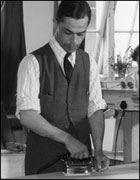 Places where men could go to learn how to do laundry and iron their shirts. To be taught how to be manly as they dusted. Enrollment has been steadily increasing over the past year. On the other hand, in the bars and cafes where the men come to be men, the older generation have grumbled that the law would change the cultural dynamics of the country, that the work around the house they’ve done for generations would now become undervalued. If a man is to be expected to wash and iron his own shirts, could he not expect that when he hands his wife the keys to the car she’d fix the ‘odd rumbling’ coming from the engine?
What I find interesting is the fact that even in this country the old question still exists: “What’s the difference between a cook and a chef? Gender.” What, exactly, is “women’s work” and “a man’s job” – in the modern world there hardly seems to be much difference between the two. That being the case, imagine the person or persons who must come up with some sort of exchange system: Three cleaned and ironed shirts is equal to one mowed lawn. One mopped kitchen is equal to one vacuumed livingroom. One fed and walked dog is equal to one fed and groomed cat. One dirty diaper is equal to one spit up cleaning. And so on.
While I applaud the Spanish Government in trying to generate more gender equality, I hardly think making chores legally mandatory is going to improve the lot of women. If anything, it will make life for them harder – sons won’t want to move out and get married if Mom is already doing all their chores for them. The better solution might be to establish mandatory pre-nuptial agreements in which the couples would outline the division of chores for themselves. Chores are like vegetables: they’re good for you, but no one wants to deal with them, and everyone has a preference. I’ll trade you my peas for your spinach; Clean dishes for a clean bathroom sink.
On the whole, the mandated 50% split of chores that the Spanish Government has put into place might be a good thing, in the long run, but for now it makes me wonder if there might not be some poor person who counts sex as a chore. For what chore would they be willing to trade?
Photo Credit: http://www.bbc.co.uk/lancashire/lifestyle/2005/03/07/vintage_housekeeping.shtml
Subscribe to:
Comments (Atom)